intrface

Voyager

One QR code gives a restaurant a multilingual AI host grounded in its own menu and hours.

Pre-launchProprietaryTourismMulti-tenantSix languages

Counted from the running system, not estimated.

6
Languages a guest can ask in
Interface and the answers the host gives.
7
Places the same answer appears
Guest, business, and the tourist board's own profile among them.
1
Place a fact gets updated
Change it once; it changes everywhere.
0
Users today
Pre-launch means pre-launch.

Three audiences, one platform.

A visitor with a phone, a business whose menu changed this morning, a tourist board answerable for what is official. One data model under all three.

Visitors

The app opens on a map, not a feed, and routes you there on foot in your own language.

Businesses

The owner loads a menu, hours, and house rules, then sees a readiness score before switching the host on.

Tourist boards

The board publishes verified profiles, events, trails, and advisories, and edits the record itself when something changes.

The parts worth naming.

Four decisions that cost time up front and are painful to retrofit later.

01

Multi-tenant authorization, checked by a test that reads the source

The tourist board and every business share one database, so a single leak ends the pilot. Permissions run through WorkOS FGA with a synchronous grant cache, and a source-level test fails the build on any route that reads data without checking.

02

Retrieval that knows when to skip the vector index

Opening hours go to a structured lookup, a menu photo to a multimodal index. Read from a column, an opening time is a fact. Guessed from a vector store, a wrong closing time is the thing a guest remembers.

03

Scraping and pedestrian routing run as our own services

Content ingestion and OSRM walking routes are self-hosted on Railway, not rented per request. Directions priced per request turn a busy August into a bill nobody forecast.

04

A design system with its own test suite

Sixteen governed subsystems make up the shared interface, tested like the rest of the code. A fix to one component reaches every surface in one change.

What it looks like today.

Screens from the current build. All of it runs on seeded Vrsar pilot content, never live traffic.

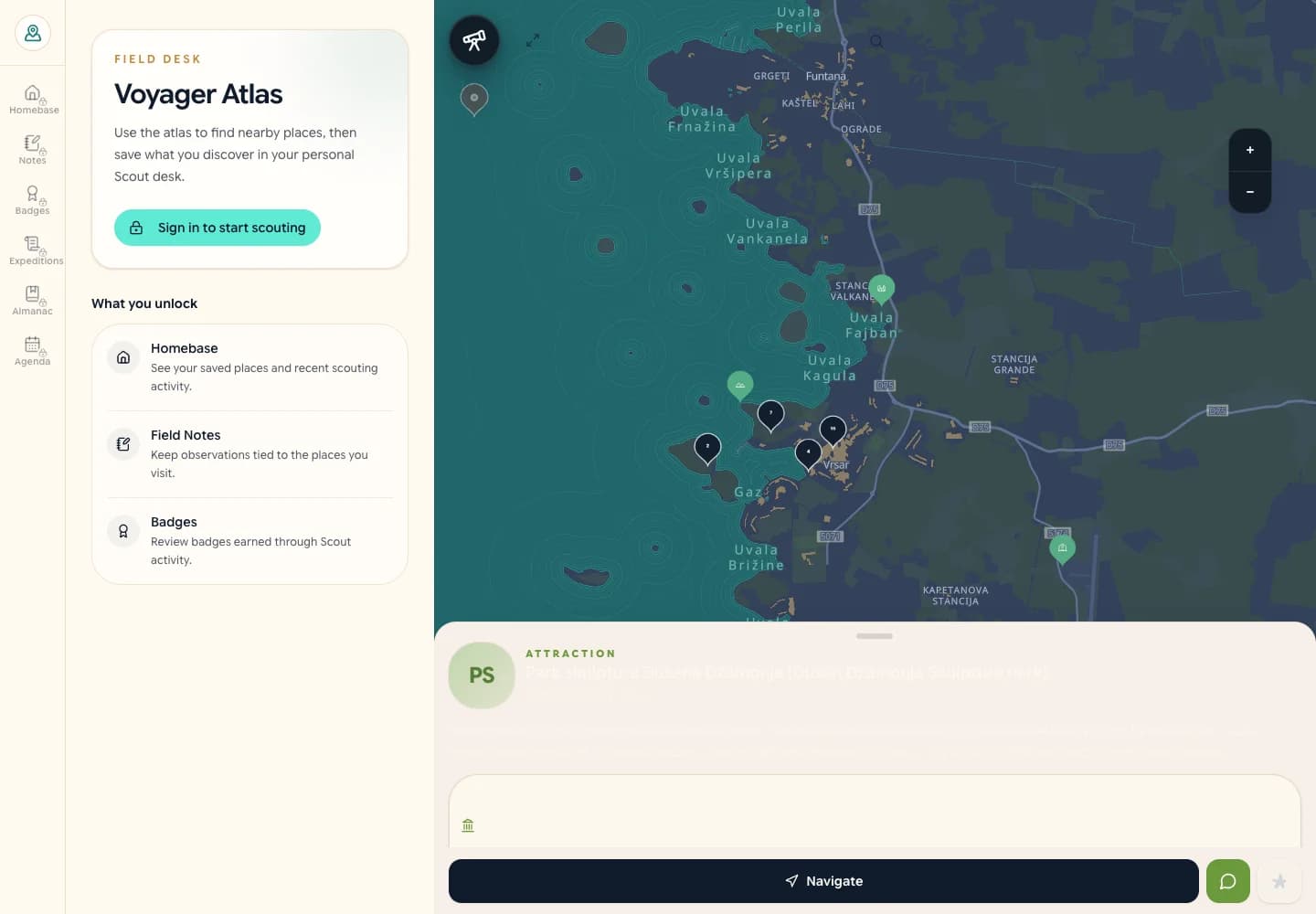
Voyager Atlas map of the Vrsar coastline with clustered place pins and a marked walking route
The public map. Place clusters, a signposted route, and no account needed to open it.
TZ Vrsar official profile with a verified badge, notices, and a register of places
TZ Vrsar's official profile: a verified badge, dated notices, and a register only the board can edit.
Nexus agent settings showing tone, specialties, and a launch-readiness panel
A business sets its host's tone and knowledge, and sees what still blocks public chat.

Seeded for Vrsar. Not launched.

Turistička zajednica Vrsar's material is already in the database, so a pilot starts with content, not an empty destination.

Named trails

Walking and cycling routes under their real names.

Sea-water quality

Bathing-water signals on the beach record itself.

Shuttle timetables

Local departures, so directions come with times.

Events

The board's calendar, published from its own verified profile.

TZ Vrsar profile on a phone, showing water quality, the shuttle, and today's events
The official layer at the width a visitor actually holds.

A destination that says go.

Tell us the destination and who owns the official content there. We will show you the Vrsar seed and what yours would take.

Discuss a destination pilot